Wilson Point Sunrise Guide: What to Expect, When to Go, and Why It's Worth the 5 AM Alarm
Wilson Point is Mahabaleshwar's most famous sunrise spot — but most people do it wrong. This honest guide covers the right timing, what the sunrise actually looks like across seasons, the jamun shot stalls, the fog behaviour, and what to do with the two hours after the sun comes up.
About the author
Neha Ranade
Destination writer
Covers viewpoints, market stops, and scenic routes around the Western Ghats.
Quick take
This guide is written for travelers planning a Mahabaleshwar trip around villas, food, viewpoints, and seasonal timing. Use the table of contents to jump between the sections that matter most.
There is a version of Wilson Point that exists in everyone's holiday photos — the one where the sun is perfectly framed between two ridgelines, the valley fog is a smooth white sheet below, and somehow no one else is in frame. That version exists. It just requires being there before 5:45 AM on a clear October morning, which is something most people discover only after they've already done the 7 AM version and wondered why it felt a bit ordinary.
Wilson Point is the highest point in Mahabaleshwar at 1,439 metres above sea level. It's one of the few spots on the plateau from which both sunrise and sunset are technically visible, though the sunrise is what the point is famous for. Every travel blog will tell you to go for sunrise. Few of them tell you what that actually involves — the road up in the dark, the specific behaviour of the fog, the vendors, the light sequencing, or how the experience changes dramatically between October and February. This guide does.
The Honest Case for Waking Up at 4:45 AM
Wilson Point is not a passive experience if you do it right. You are setting an alarm for 4:30 or 4:45 AM. You are getting dressed in the dark, probably in layers, possibly over mild protest from anyone sharing your room. You are driving a narrow uphill road in low visibility. None of this is glamorous.
But here is what happens when you arrive before the sun: the sky above the eastern ridge begins to change from black to a very deep indigo-blue, almost imperceptibly at first. Then a faint orange line forms at the horizon — not yellow, genuinely orange, thin as a thread. The valley below is filled with fog that you can't see properly yet but can feel in the cold and damp of the air. The other people who are already there — usually a small handful at that hour — are quiet in the way that people are quiet when something is about to happen.
The light builds. The fog starts to glow from within. And then the sun clears the ridgeline and the entire valley floor ignites in pink and gold and the fog catches it and scatters it back. That's the moment. That's what the 4:45 AM alarm is for.
The 7 AM version — which is what you get when you follow the tour bus schedule — is still a valley view. It's still technically Wilson Point. But the soft light is gone, the fog has either dissipated or locked in thick enough to block everything, and there are significantly more people. You can decide which version you want.
Timing: Month by Month
October and November
Post-monsoon Mahabaleshwar is extraordinarily green and the air has been washed clean by months of rain. October sunrises at Wilson Point can be genuinely dramatic — fog in the valleys is common, the vegetation is lush and dark, and the light quality in this period has a particular clarity that later months don't always have.
Sunrise time: approximately 6:10–6:20 AM in October, shifting to around 6:30 AM by late November.
Arrive by: 5:30 AM. The pre-sunrise sky transition — from deep blue to the first colour — begins about 45 minutes before the sun actually clears the ridgeline, and that transition is worth being there for.
Fog behaviour: Valley fog is most common October through January. In October, the fog can be low and dense, lying flat in the valleys below Wilson Point while the air above is clear. This is the classic layered effect that produces the best photographs.
December and January
The coldest months and some of the best sunrise conditions. December mornings at Wilson Point can drop to 7–10°C before sunrise, with wind chill making it feel colder. Dress accordingly — a light jacket is not enough. You want a proper warm layer.
Sunrise time: approximately 6:45–7:00 AM in December and January, which is later than you'd expect but still requires arriving well before.
Arrive by: 6:00–6:15 AM. The longer pre-dawn window in these months gives you more time to get positioned and actually cold enough to appreciate the warm chai from the stall at the top.
Fog behaviour: Peak fog season. On certain mornings, the fog covers the entire valley system and Wilson Point sits above a white cloud layer. The sunrise in these conditions breaks above the fog rather than over a visible valley — the light spreads across the top of the cloud layer in sheets. This is a different experience from the layered October version but equally worth seeing.
February and March
The weather warms, the fog thins, and Wilson Point shifts to a different kind of experience. The views become sharper and the distances more visible — on clear February mornings, you can see very far across the Sahyadri ranges, farther than the misty October months allow.
Sunrise time: approximately 6:45 AM in February, pulling earlier to around 6:20 AM by late March.
Fog behaviour: Less common than peak winter. Some mornings have residual valley mist; many are simply clear. The compensating factor is visibility — February and March offer the clearest far-distance views of the year.
April and May
Peak tourist season. Wilson Point in May is a different exercise entirely — arrive before 5:30 AM or you will be parking on the road below and walking up. The light is still there if you catch the pre-sunrise window. The crowds arrive fast after 6 AM.
Sunrise time: approximately 6:00–6:10 AM.
Note: Heat haze reduces long-distance visibility in summer months. The sunrise itself is still good, the far valleys less sharp.
Monsoon (June to mid-September)
Wilson Point in monsoon is not a sunrise experience — it's a fog experience. On most monsoon mornings, the entire plateau is inside cloud cover. You see white in every direction. The light changes in the fog rather than through it.
This is either compelling or frustrating depending on what you came for. Photographers who work with fog conditions specifically (rare light, isolated figures, saturated greens) find monsoon Wilson Point excellent. Anyone expecting a valley panorama will not get one.
Weather note: The road to Wilson Point can be wet and slippery during heavy monsoon. Check conditions before attempting the drive.
The Road Up: What to Know Before You Drive
The road to Wilson Point branches off from the main Mahabaleshwar plateau road and climbs steeply for roughly 2 kilometres. It is narrow — two cars can pass each other if both slow and pull slightly, but there is no comfortable margin. In the dark, drive slowly.
Parking at the top is limited to perhaps 20–25 vehicles in the designated area. On busy mornings (weekend winter months especially), this fills before sunrise. What happens is: cars start parking on the road leading up, sometimes 400–500 metres below the viewpoint. Walking that in the dark, on a road with no pavement, in cold weather, is manageable but plan for it.
If you are driving from a villa in the main Mahabaleshwar area, leave no later than 5:15 AM for a December or January sunrise. For October and November (earlier sunrise), leave by 5:00 AM.
Local auto-rickshaws and drivers offer Wilson Point sunrise runs — some villa caretakers can arrange this. If your driver knows the road well, this removes the parking stress entirely. Ask the villa host the evening before.
The Jamun Shot Stalls: A Wilson Point Institution
Halfway up the pathway from the parking area to the main viewpoint, you will find a small row of vendors operating in the dark with battery-powered lights. They sell chai in clay cups, boiled eggs, and — most distinctively — jamun shots.
Jamun is Indian blackberry, Syzygium cumini, a fruit with a deep purple flesh and an intensely tart, slightly astringent flavour. The stall vendors here press fresh jamun and serve it in small glasses — sometimes straight, sometimes with black salt and lime, sometimes with a thin slice of ginger. The drink is extremely cold (the fruit is kept in chilled water), deeply coloured, and bracingly sour.
They cost ₹20–30 per glass. They have become part of the Wilson Point ritual to the point where some people's clearest memory of the sunrise is the jamun shot they had while watching it. This is not hyperbole. The combination of the cold temperature, the sharp flavour, and the early-morning context makes the experience oddly memorable.
The chai is also good — strong, sweet, served in clay kullads that you can throw afterward in the bin provided, which most people do but some tourists inexplicably pocket as souvenirs. The vendors have seen everything.
Looking for a villa close to Wilson Point with an early-morning driver arrangement? Browse Mahabaleshwar Villa Stays — our properties near the main plateau road make sunrise runs easy, and caretakers can organise local drivers for the predawn run.
At the Viewpoint: What You're Actually Looking At
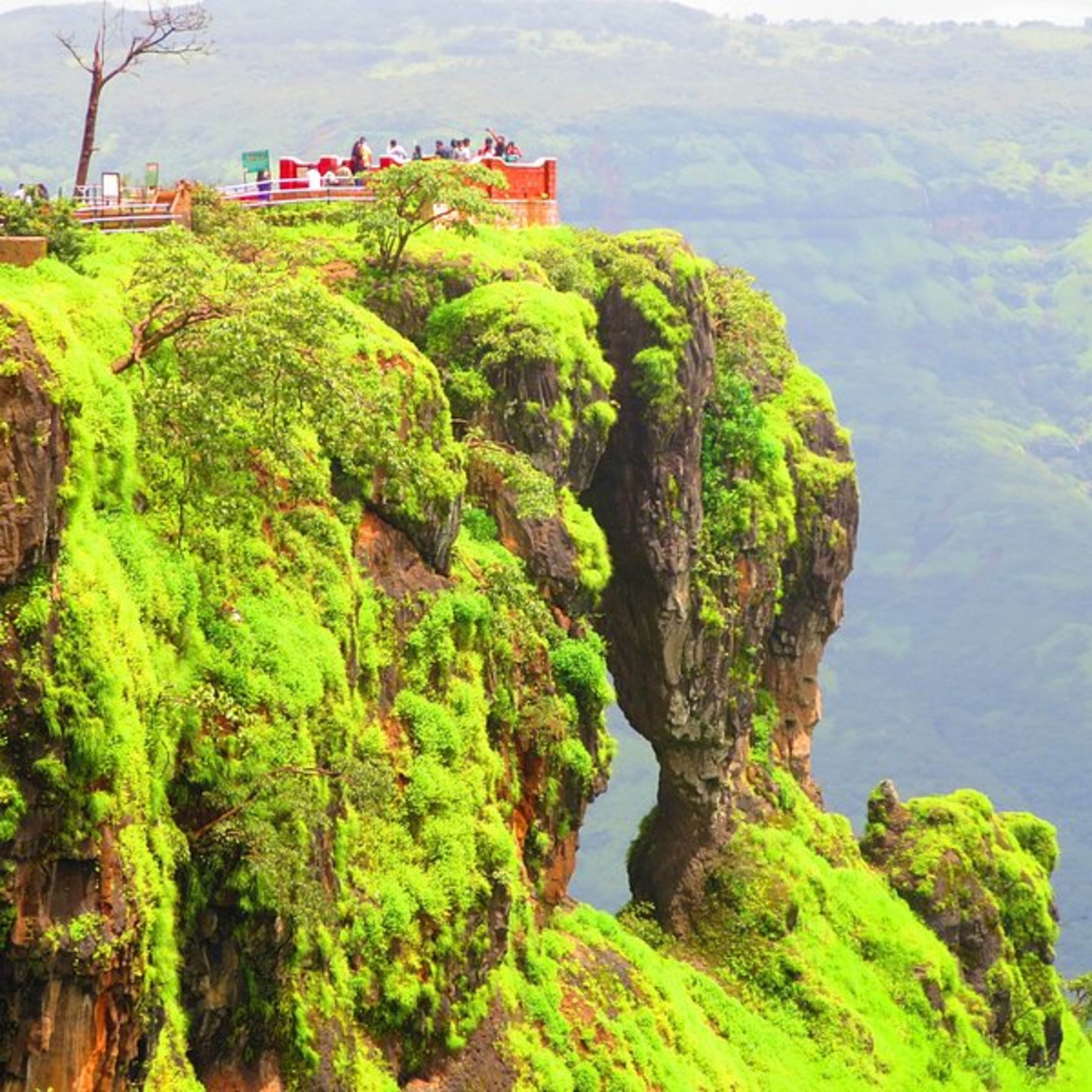
Wilson Point's main viewing area is a railed terrace at the top of the climb. On a clear morning, the view from here covers multiple valley systems simultaneously. The landscape visible from Wilson Point includes:
The Krishna Valley to the southeast — the valley through which the Krishna River eventually descends to the Deccan plateau. On clear mornings this valley is visible as a deep green corridor between ridges.
The Koyna River basin to the west — more heavily forested, darker, often carrying more fog.
The plateau edge itself — from Wilson Point you can see how abruptly the Mahabaleshwar plateau falls away into the Konkan below. On exceptionally clear days, the Konkan plain is visible as a lighter-coloured area far below the cliff line.
The ridgeline to the east — this is where the sun comes from. The specific ridge and peak over which the sun rises shifts by about 15 degrees between October and March, which changes the exact angle of the early light on the valley below.
Positioning for Photography
The best position at Wilson Point for sunrise photography is slightly to the left (north) of the main central railing. From here, the ridgeline is framed by vegetation on both sides and the valley below is visible without the railing interrupting the foreground.
For phone photographers: expose for the sky, not the foreground. The valley will be dark initially — let it be. Tapping to expose for the bright horizon makes the sky white and kills the image. Expose slightly above the sun's position and let the foreground go slightly dark; the warm light will fill it in within 10–15 minutes of sunrise.
For DSLR: bracket at minimum three exposures (−1, 0, +1 stop) and blend. The dynamic range between a bright sunrise sky and a fog-filled valley is too wide for a single exposure in most cameras.
After Sunrise: The Two Hours People Waste
Most visitors watch the sun clear the ridge, take photographs for 10–15 minutes, then turn around and drive back. This is a reasonable choice if you have a packed schedule. But the 30–60 minutes after direct sunrise are often the most interesting photographically and the most peaceful experientially — the light shifts from orange-pink to gold, the fog starts to move (either dissipating or consolidating), and the crowd that arrived at 6:30–7:00 AM has by then partially departed.
Stay for the movement of the light across the valley. Stay long enough for the chai to cool slightly and be worth the second cup. The viewpoint at 7:30 AM on a clear morning is often better than at 6:30 AM, and by then the parking situation has also eased.
After Wilson Point: What to Do with Your Morning
Leaving Wilson Point before 7:30 AM leaves you with a full morning and, because you woke up at 4:45 AM, a mildly surreal quality to the rest of the day. Recommended continuations:
Old Mahabaleshwar Temples (8:00–9:30 AM)
The Panchganga Temple in Old Mahabaleshwar is 6 km from Wilson Point and worth the short drive. At 8 AM it is quiet, the priests are unhurried, and the five-river confluence below the temple has a particular stillness after the energy of the sunrise crowd. This transition — from the dramatic to the contemplative — works well as a morning sequence.
Kate's Point (8:30–10:00 AM)
Kate's Point, roughly 7 km from the main market on the Panchgani road, overlooks the Dhom Dam and Krishna Valley from a different angle than Wilson Point. The morning light on this valley — east-facing, still relatively low in the sky at 9 AM — is excellent for photography and the point is typically much less crowded than Wilson Point. Read more about the viewpoint circuit in our complete Mahabaleshwar itinerary guide.
Breakfast at Mapro Garden (9:30–11:00 AM)
Mapro Garden opens at 9 AM. Arriving here after Wilson Point, with the appetite that comes from a 4:45 AM wake-up and two hours of cold valley air, makes the Mapro pizza and the fresh strawberry milkshake feel genuinely earned. Weekday mornings before 10 AM, the garden is quiet. This is the version of Mapro Garden worth visiting — not the Saturday afternoon one.
Common Mistakes at Wilson Point
Arriving after 6:30 AM on a weekend and expecting the experience to be the same as the photographs — it won't be.
Dressing for a warm Mahabaleshwar afternoon when it is actually a 5 AM ridgeline in December — the temperature difference between your villa at 11 AM and Wilson Point at 5:30 AM can be 8–10 degrees, plus wind.
Skipping the jamun shot because it doesn't look impressive — this is a mistake. Spend the ₹25.
Expecting the fog every morning — fog at Wilson Point is common but not guaranteed. Clear valley mornings without fog are still worth the sunrise; the light and the distance views are different but not inferior.
Leaving before the light fully develops — the 15 minutes after the sun clears the ridge are often the best of the entire morning. Stay for them.
Villas near the Mahabaleshwar plateau road allow you to reach Wilson Point in under 10 minutes from your front door. Browse private villas on Mahabaleshwar Villa Stays and filter by proximity to the main sightseeing belt.
Need a villa base for this trip?
The best travel blogs work when they point to a real booking decision. If this article helped you plan the route, match it with the right villa category before you finalize dates.